One of my intentions with this blog is to try to post as the action happens.
I have begun my story of buying my first (real) incoming-generating property in Japan in the middle of the process. I have a lot the early steps I’d like to go back and fill in, share those details. But as for this post – it is “as it happens.”
This week we “passed” on a deal. And it hurts (a little), because it is the first property we have really even taken seriously.
“This is the right junction to admit that sometimes it’s an excellent idea not to close on a deal.”
— William Poorvu, from the book The Real Estate Game (1999)
In addition to hunting for real estate investment property, I continue to actively study. I’m currently reading The Real Estate Game (for the second time). I read that quote above today at lunch, and it reminded me that I wanted to write about how my broker convinced me to “pass” on this deal.
The building was over 20 years old, almost 20 small, one-room units. Not in a perfect location, but – it had functioned as a rental property for a long time, and was objectively central, if not that close to a station (15 min walk). The property itself was “acceptable” looking, in terms of curb appeal, but also clearly needed some work (some delayed maintenance was apparent from the street).
The property was exciting because it checked a lot of the boxes I have for how to do what the pros call “forced appreciation.” I could see multiple ways to add new revenue, above and beyond cleaning up the interior of the units.
As a part of this process, I am meeting with my broker in person about once a week. My agent and I are establishing a nice rapport, and he has been giving me more of his time than I should expect.
At a previous meeting, my agent gave me a stack of properties to review. As a foreign buyer, I’m “low probability” in terms of certainty of closing (foreign buyers are much less likely to actually complete a deal than local buyers with equivalent experience). I live here in Japan, full-time, but even so, my foreignness generally adds friction to the deal, and the agents know it. Because I am a “low probability client,” I try to make this process as easy as possible on my broker.
When he gives me properties, he just gives me basic one-sheet print outs, and I go off and locate those properties on a map, jump in my car, and look at them, entirely on my own.
While it is true I have a decent budget (I do); of the set of clients that might complete a deal, as a first-time buying in this country I am arguably the worst type of client in that set. So, being in that “class” of clients, I want to be the very best of those “worst” clients. I think I have been, so far.
I’m working really, really hard on this deal. Using a lot of my own time and resources, going after so many angles for loans, etc. And I’ll do anything my agent asks of me.
So, my broker gives me this property, and I went and saw it, along with seven or eight other properties. I personally show up, walk the property, take pictures. I brought pics and notes on each property back to my agent. We have done this for several weeks. This particular one, I was actually a little excited about.
I knew the price was too high, but what I said was:
“If I had to make one of these properties work, this is the one I’d try to ‘develop.'”
At the right price, and with the right amount of work, this deal could be awesome for someone.
(I still do kind of wish that someone was me… but we’d expect a newbie to want that. I am trying to contain that newbie within.)
In the meeting after I brought my notes on this property back to my agent, he showed me the rent roll; there were a lot of vacant units. Really? Interesting. Why? The reasons my agent shared with me was that the owner didn’t have the cash to update the vacant units, so they sat empty. Huh, sounds like an opportunity.
The next week, as I did “my homework,” I looked at 14 new (meaning: old and undesirable properties, that were “new” to me), and I circled back and looked at this building again. I walked it again. I formed another set of questions about the building; including the ground floor, which had windows, but wasn’t listed as having any apartments. If that was storage, or whatever, why put windows on that exterior wall? Just for design?
In the next-next meeting, I presented all this “street time” back to my agent. Based (probably mostly) on my enthusiasm, he picked up the phone and called the seller’s agent.
(Good agents use the phone for more than texting. They call each other, and It is cool that agents want to sell this stuff, and you can just call them, and they pick up.)
My agent said the guy on the other end of the phone was located in another city, that he was a bit “pushy” (rude), didn’t have much information, was rushing to get off the call. We did get that agent to give us the “key code” so we could go by and look at some of the empty units. And we did just that.
We jumped in my car, drove 10 – 15 minutes across town from my agents office, and walked the property together (it was my 3rd time on site).
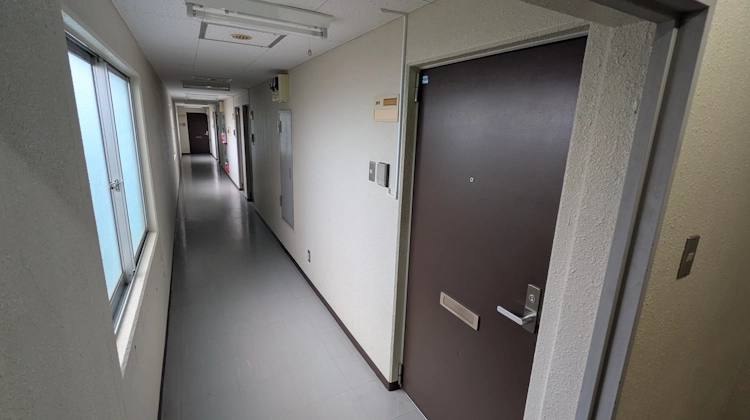
I love the hallways of this building.
One of the things I’ve noticed is that the hallways in most of these older “class C” rental properties in Japan are very uninviting. They were often built “cheap” to start, and then set up individual utilities meters for each unit as an afterthought, so they are mounted to the walls in hallways, like a kind of pipe-connected cancer out in front of each door. Really ugly. A good hallway (indoors, average height ceilings, low-profile meters, no weird smells) is rare in this class of building. For the part of my strategy that would like to attract a better quality tenant, it is my belief that good hallways will be necessary. This building has clean, very “acceptable” hallways. (I could live in this building.) That was a good start.
For comparison, you want to see some “bad hallways” in a Japanese rental property?

This metered-monstrosity is fairly typical. With love and respect to the renters in that building (this particular building is like C-, or D+ building, but at least some of the tenants have some heart), that is not a “nice” hallway. And a building like that is destined to have the same (or worse) tenants over time. I don’t know how to fix that kind problem… and I’m not going to try. Those building will always be an easy “no” for me.
Of all the (50ish) properties I have walked in this market, the building at the center of this post has the cleanest hallways.
While I was right that there probably are some “relatively simple” ways we could force NOI up via some improvement to the property – in the individual units, of course, but also to the exterior and common areas – the building is in rough shape.
Here is a pic from the building to show some of the current condition.

That is not a perfect example – maybe I should have posted the exterior pic with part of the building peeling off?
The interior, at least, really, not bad. Not scary. There are other issues that are more intimidating (I don’t have good pics handy). But these issues seems manageable with a minimal cap ex for improvements.
When we toured the units, they were no worse than I imagined, but my agent really didn’t like them. Several had significant mold/mildew on the walls. In my experience, this is common in Japan (more so that property I know of in the US). But my agent was shaking his head.
We did discover, however, that those “windows” on the first floor (where there were not supposed to be any apartments, were actually the bedroom areas of the apartments on 2F; you enter the “1R” unit on 2F, and then go downstairs into a decent bedroom. None of these 1LK units were on the sales material. The “secret” 1LKs are only true of 4 of the 20ish apartments, but, it was “discovered” value (we had thought they were all going to be one room). Everything needed a lot of work, but the units were so small, simple accommodations, it would not take much to re-hab them, and my imagination ran wild with possibilities.
But, but… some many were covered with that black “keebe” mold. There was also some damage around the windows in several units.
My agent sent me off to ask some questions of local lenders (I used someone on my staff to do the communication in Japanese). At the close of that site visit, he still seemed open to this building.
I was excited, and yet: I immediately tried to park my expectations. This building was a big one, and a labor intensive one. It would need a lot of extra cash after closing (which I actually have) to get it on it’s feet. It did seem likely this might all be too much for my experience level.
I was ready for my agent to shut it down, and I was encouraging him to keep me grounded.
“I *only* want to do a deal where you think I can be successful.”
That next week, along with my research/homework with the lenders, I did quite a bit of daydreaming, but kept reminding myself – this was statistically unlikely to work out.
Was I really going to buy the first deal I had seriously considered?
At that next meeting (which was just a couple days ago), I showed up with my complete research/homework, I had something positive about a loan to report, and I was eager to hear if my agent had learned anything else from the pushy seller’s agent. As we got started, I could kind of tell he was going to shut it down. As soon as the topic came up, he made a face and said we should pass.
Okay, I said. Immediately. I get it. This is what I want. I want guidance. So, “pass” it would be.
My agent says that mold probably will be recurring. He thinks the building was originally built “below quality,” so even if we spend money to fix that up, the problems will come back. More repairs. Ruined property. It would be “buying problems.”
He is probably right.
He gave me another property to look at – one I have already visited, twice – noting that the property just reduced it’s price. We went to look at that one, together. I could see it as a source of revenue, it may be a good investment, but it doesn’t check the boxes I want for some of my more “grand plans” (which could bring a higher quality of tenant).
This second building has “ugly hallways.” They are open to the exterior, the meters are pretty bad. High-end tenants won’t like this building.
I love that I have enough experience to know that hallways are a differentiator in this market. No one pointed that out to me (I’ve never heard that, not anywhere), but I know it’s true. When I see good hallways, I see potential.
Anyway…
“If you were to compare the pile of good deals that don’t get flooded with the pile of bad deals that do get funded, the latter pile would be bigger.
“My advice would be: trying not to add to the ladder pile.”
— William Poorvu
My agent is probably right. And so is Poorvu. I don’t need to fund another “loser” deal. I can’t afford to – at this very-early stage of my career, when I am trying to prove myself, I need a win… not a moldy money pit.
It was hard to pass though. A little bit hard. Who knows, maybe I’ll have to pass again and again, to fight down the excitement, before I find “my baby.”
That is today’s post