My broker was traveling this last week, so we didn’t move forward on anything, but I had my homework to do; I researched a couple of related property NOI ideas, I shared some examples about nisetai foudousan (duplexes, in Japanese) with my broker, and I went out to see about 14 properties my broker and one of his agents had sent me.
In today’s post, I’m going to share some pictures from this week’s property visits, as well as an idea that I heard this week on a real estate podcast I was listening to:
“It’s just higher quality of tenant. I get better people. I make my places nicer. I take care of them. I get nicer people. And I don’t buy anything, whereby I couldn’t do that.
— Ben Leybovich, from the Lifetime Cashflow Podcast (episode #16)
I like this line, especially that last part about “I don’t buy anything” that won’t fit a higher-quality tenant. He doesn’t buy anything that couldn’t *potentially* fit a better, more desirable tenant. That line kept ringing in my ears all week.
In my last post, I talked about looking at “bad deals” on the local Japanese websites that have investment property for sale (the “LoopNet” of Japan). I said this:
>>The assignment for new investors is to comb through the trash, and fish out something that is not inherently valuable, but can be reshaped into something valuable
Okay, so, maybe that is right: Because I don’t have the reputation or connections to get access to better deals, I have to sort through the bad offers I can find online, and sift out a property that can be made into an attractive place to live. If the investment property websites in Japan are only for the bad deals (just like investment property websites in all markets; the best properties are sold, offline, to insiders), the question is:
Just how bad a deal should I be considering?
I like that line from Leybovich because he sets you up with a clear boundary; it’s guidance for what to aim for and what to avoid.
Don’t buy any property that can’t be improved to a point where your target tenant will want it. In my case, I do want a higher-quality tenant.
“You don’t buy anything that doesn’t lend itself to attracting a stable, responsible tenant base. You still have to manage them. But they’re manageable. So many people aren’t manageable, because they’re so unstable.”
— Leybovich
In that podcast, Leybovich is teaching listeners about how to avoid expenses associated with low-end tenants. In my case, I’m taking his comment and focused on the upside, about finding buying an asset that will fit the lifestyle of higher-quality tenants.
Without going into all the details; I’d like to be able to attract professional tenants. I’d like to potentially attract international professionals, “digital nomads,” professors, grad students with money, etc. I’m not talking about Class A property. My goal would be to buy a distressed property that is currently a “C” property (probably with a lower class of tenant), in a B neighborhood, and raise it up to a B+ standard (where more affluent tenants would feel at home). That should allow for better cashflow, an increase in NOI, and a better exit down the road.
So, let’s get to it; what did I look at this week?
Here is an example of what I saw.

This one was 27 units, on four floors (what is that, 7 rooms per floor? With 6 on one floor? Odd number of units.). This building was built in 1989. It’s a hideous pale pink (which seems to be the most popular color in all of Japan). The location was pretty good; not far from a convenient station, near the university. The exterior would be hard to improve. Inside, very dated, worn, but, the interior had some potential.
What about my goal of attracting professional, higher-income tenants? No. I don’t think so. The exterior is so dated and objectively ugly, it would take a lot of money to change it’s curb appeal.
If I’m listening to Leybovich, and I am; this property will never fit my target tenant. So, it’s a pass.
Here is another one.

This building looked okay from the street. But as I rolled around the side, I had a better idea of the building’s class. That is a 21-unit class C building (C-?) that will always be a class C/C- building. That won’t work either.
Here is one I liked better.

How is that for a pretty hallway? I am only 1/2 joking. That is, in fact, a very nice hallway for my class of building. That hallway is not “nice,” but it’s interior (as opposed to exterior), and it’s not ugly.
This building is 9 units, 2LDK each. It’s not in a great location (not close to any train station), but it’s close enough to one of my favorite properties that I know it’s a fast bus ride to the center of the city (18 mins)?
Here is another view.

Can you tell which units are vacant? They may all be, but we know 201, 301, and 401 certainly are. Why are all the xx1 units empty? That is weird. Maybe there is something wrong with that corner of the building?
You can also tell from that picture – with old tape marks on the wall, the random room deodorizer – this building isn’t getting a lot of love.
Here is the entrance.

Those grey, horizontal bars on the floor by the door are there to catch water and dirt (I guess?). You can see a small pile of those same bars pushed into the corner (on the right). That mat is a cheap effort to hide/mitigate the the area where the broken bar came from. It’s all so sloppy.
Maybe I am naive, but I can’t imagine letting my building fall into this state. And it gets worse…
Want to see how bad?

This is the back of the building. Those sections are rusted and rotted out. I assume they are some kind of poorly designed architectural feature, maybe they cover steel beams? That is some real cap ex to clean all that up.
Meanwhile, the projected rental yield on this property is under 8% – relatively low for this market. That is projected yield; actual yield is presumably much lower than that (we think at least three units are empty).
This building is a great example of what I mean by “bad deals online.” It’s a bad deal – low yield, poor condition. No wonder none of the well-connected buyers want this one. No wonder it is listed online. These are the kinds of deals available to uneducated buyers (that don’t know online listings are a bad source of investment property) or new investors… that don’t have access to better opportunities.
This building has some potential, but not at this price. It could, possibly, maybe even work for my desired tenants. But it’s an expensive mess, and I’m not even tempted. It I were going to take on an expensive mess, I’d take that deal I passed on (which I not-so-secretly still want). This one will sit on the market for a while.
Above we saw that mailbox shot – I often take a picture of the mailboxes. It helps me remember how many units are in the building, and – cleaning up the mailboxes is an easy way to improve tenant experience and to raise perceived value of the property.
Here is another set of (ugly) mailboxes.

How many units are empty here? At least three, right? Maybe more.
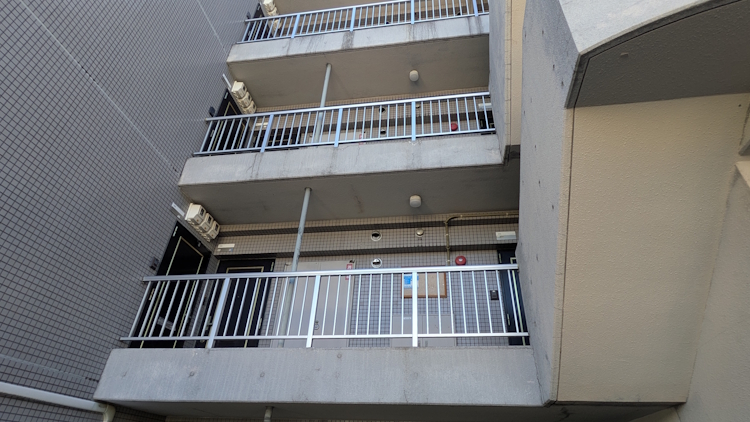
This is the same building from the shot I used for the main photo for this post. It’s 17 units on four floors; two commercial units on the 1F, and three floors of apartments. Really ugly building. No way I would be interested.
Here is a hallway from that building:

The picture is nicer than what it was like to stand there. This building will never attract nice tenants.
You want to see the worst one of the day?

That is actually the entrance to the property. It’s on a tiny “private” (non-city) road, next to some perfectly normal, middle-class homes and rentals. But this property was always insultingly low quality. What kind of tenant wants to live in a place like this?
“If it’s the wrong kind of asset, there is nothing You can do. You are not going to convince good people to move into a bad asset.”
— Leybovich
There was a proper Japanese akiya on this street.

Akiya in Japan are always kind of beautiful to me. Broken, but with more charm than the no-effort apartments I am otherwise looking at. This one had big wooden ladders built into the front of the building. It was unique, interesting. Half swallowed by vegetation and ready to be torn down. I am not interested in buying akiya in Japan, but I do like to look at them, they are always more charming than modern construction.
“For me, even after five years of living in Japan and continually seeing things more and more with Japanese eyes, I still prefer the older buildings. They have soul.”
— Anton Wormann, from the book Free Houses in Japan
That was one of two akiya I saw that day. The other one, completely covered in vines, may even have someone still buzzing around inside (it was a really beautiful property, too).
Back to apartments: want to see a better property? Not a lot better, but a little bit better?

How’s that for a nice hallway? This building is not “nice,” but it’s so much better than most of the buildings I have seen on the “LoopNets” of Japan. The first floor hallway is more of a mess, but the 2nd, 3rd, and 4th floors all look like this – clean, big clear windows, healthy looking place to live.
This building is all 1RK units (no proper bedrooms, these are studio apartments in Japan), but… I could imagine being comfortable in this building. Could I attract better tenants to this property? Possibly.
It’s big, it’s old, so many units, I bet it just prints money. A big cashflow machine.
You want to see one of my favorite properties in my search?

There she is – gorgeous, isn’t she? Want to go partners on this one? No? You’re not excited to invest your savings with me in this charmer?
When I see that bike, on it’s side, against the wall, where it has been for at least a year, surrounded by weeds that come up to your chest – again I wonder how you could let your property get this bad? I wonder why the tenants don’t clean it up themselves? Why do they continue to live on a property this neglected? I have never, in my life, lived like this.
I like this property not because it has nice hallways (they are ugly, and are open-air, and face an ugly neighboring property), but because I can see how I can easily implement about five to 10 things that would make this property much, much nicer. It’s 15 units, needs a lot of work, but – at the right price, this one might have potential. I can handle the old, junker bikes (there are more than one, there are a pile of them).
“There is very little you can do as an owner, to attract a good tenant base. Your asset attracts the good tenant base. What it is, where it is, within your marketplace.”
— Leybovich
He is not saying “there is nothing you can do.” What he has been saying – in all the quotes I’ve included in this post – is that the asset itself (not the owner) has its own limitations or potential. Assuming you will do much better than the property managers of the buildings we have seen here today, assuming you will do all you can to improve the property and it’s operations…
The asset has to have the potential to fit the kind of tenant you want (preferable a stable tenant, to Leybovich’s point). I’m using his idea as a screener, to eliminate properties; it’s helping me to know what I want.
That’s all for today’s post.