It’s been weeks since I posted an update. My deal “MaruDu” was mostly-on, then mostly-off, and as of today, I’d say it is maybe 50% likely to happen – but, it’s dragging on, it’s dragging out.
In my last post I talked about an offer I have out to buy a two-unit home in my city, to be delivered vacant, and to be used as an investment property. I shared the actual offer letter my agent and I sent the seller. I thought it had only been a week or so since I last posted, but I checked and it’s been almost a month.
I do not have a signed sales agreement for this deal. And there have been some developments.
Did I mention there is an issue with the property line at the property? No? Well; the property I want to buy has a low retaining wall that protrudes about 3-4cm (maybe 2cm, actually) onto the next-door neighbors property. I knew that before I made the offer. I believe sometime after I made my offer, the seller’s agent let us know that owner of the adjacent property will not sign a “memorandum” agreeing to “live with” the current condition; they want it resolved (now), and are using the sale to exert pressure. This issue does not technically stop the sale, but without this “memorandum” (which is not an “easement,” I don’t think, it is something less than that), the bank will not issue the loan. So, it effectively stops the sale for me until the wall issue is resolved.
But wait, that’s not all.
Do you know what “building coverage ratio” means? Well, I do. I do now. Building coverage ratio (BCR) or kenpeiritsu (建ぺい率) is the percentage of the plot of land occupied by the footprint of the building. You can’t built up to the edge of the property (right?); so how much of the property are you allowed to cover? For the building I am trying to buy, the answer is 60% of the square meterage of the property. All the paperwork for my deal says the building is in compliance, including all the paperwork signed by the city at the time of the original inspections. However, if you actually bother to calculate the numbers yourself, you’ll discover the building is about 1% too big.
[Insert your own explicative here]
The seller’s agent, for who knows what reason, decided to do that calculation, but not until after we’d made our offer. We’re not bound by anything. We could walk away. There are now two known issues on the property… maybe we should walk away? I had a meeting with my broker, and I had already come to (partially) accept that conclusion.
What does the BCR issue mean, in practical terms? Is it blocking the sale? Oddly enough, it is not. My broker (much love to my broker, once again, I am a big fan) all of his own initiative called the bank we have been talking to, and the bank said (this is non-binding, but they volunteered it) that it will not effect the loan. Oh? My broker was surprised. So am I. Good on him for checking on it already.
So, the retaining wall issue is still a limiting factor, but the BCR is not.
Once the bank has some evidence the retaining wall has been resolved, the sale could move forward. But would we want that?
If you haven’t already put this together, the issue with the BCR is that it could be difficult to sell the building later. That’s it. That’s the issue. My agent is confident the city does not know the BCR is in violation, and would not enforce any penalty, as the “1%” variance is not big enough to note. I can think of two (expensive) ways to remedy the problem, but for now, no one cares. But if I were to buy it, and try to sell it later, we’d have to find a seller that would also not care that the BCR is over the limit. Other banks might also balk at that defect. Those are potentially real liabilities.
So, we should walk away, right? Well, we could. But…
I mentioned that we offered about 10% below the asking price when we wrote the offer. They had a yet-to-be had meeting scheduled with the complaining neighbor, and were waiting until after that meeting to move forward. When they announced the BCR issue, that was a significant and new defect with the property; does it merit a change in price?
I almost feel bad for the seller. They started at one price, didn’t sell it. They sort of soft-discounted the price, and we came in far below that. They officially lowered the price, and then they discovered the BCR, which does seem make the property even harder to sell. Anyone interested in buying this property has to – like me – wait around for one issue to be resolved, and then potentially swallow the larger BCR issue.
So many problems. Price could come down, yet again.
What is the value of the land, alone, I wondered? I asked my broker, because I was curious how close we were to a price that effectively discounted the entire value of the building. He gave me a number, not terribly far from our first offer.
Let’s talk about cash flow for a moment: This property has never been a rental before. It has two, nice units, in a very nice part of town (admittedly a bit far from the station, but with two separate garage spots). We don’t know what it will rent for, but my modelling expects it to rent for as much, or more, as similar 2LDK apartments in the neighborhood. It should rent for about 2X the mortgage payment. There should be some, maybe actually decent cash flow after expenses. I’m new to being a landlord, and this is a unique property, so we can’t be certain.
What if we lowered our price, again? If cash flow was “okay” at our original offer price, and we had a legitimate reason to reduce price again, if the sale closed and we could get it rented, cash flow is not effected by any of the issues with the property, a lower price would mean better returns. It may indeed be difficult to sell, but if it’s in a great location, a high quality building, we could just keep it for cash flow. My agent seemed interested and vaguely supportive of all that.
So, we called the other agent and changed our offer. And the agent said, “we’ll see what the owners say,” and everyone made me wait several days. The waiting is not fun.
Okay, fine. If they take it, I’ll take it. If they don’t, let’s get to work on some other property.
I told my agent (he is great, thank you Mr Agent) I wanted to move on, and assume this deal would not happen. The poor sellers; the price is increasingly far from their initial expectations. I mostly assumed they would not accept our offer. I’m still not sure that they have. I asked my agent to give me some new property to look at ASAP.
A few days later, my agent let me know that the sellers had “basically” accepted my new offer.
Here is exactly what he said:
“Regarding the price, it seems that 42,000,000 JPY is generally acceptable.”
— My agent
Is that a yes? I’m taking it as a maybe. We are waiting on cost to fix the retaining wall (which means; to tear it out, clear some of the soil, rebuild it entirely on our side of the property).
We’re waiting. The waiting… terrible.
Prior to the the not-quite acceptance of my offer, I asked my agent for some more property to look at. He still likes this “duplex”/nisetai plan. He prepared 12 new duplex properties for me to look at, I had those on Tuedays of two weeks ago. I was scheduled to go to Tokyo for the Japan Real Estate Summit that weekend, so I got busy and looked at the property before I left.
I’m trying to be a good client, I’m really trying. The delays are never about me.
I looked at nine of the 12 properties, in person, and it took almost all day. Three of those properties were pretty nice, actually. One, looked like a real winner.

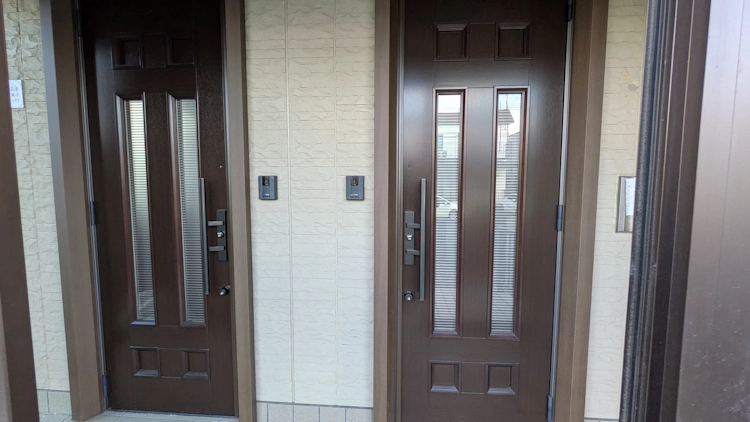
I’m sharing a picture of the entrance to one of two units in a side-by-side duplex here in Japan. It’s an all-concrete duplex, which is rare, and probably would mean access to more/better loans. I liked it. I liked three of the “nisetai” I saw that day. I messaged my agent, but… I assume he thinks our current deal will close.
To be honest, I would be glad to go full speed ahead and try to find another deal. I don’t like waiting when all I have (so far) is a “maybe.” But, I will say, of all the investment property I looked at that day, I still like my “MaruDu” the best. Seeing nine more comparable properties made me like my deal a little more.
I got that work done on Thursday of last week (10 days ago). The following day, I jumped on a aeroplane, and zipped off for a few days in Tokyo, where I attended the Japan Real Estate Summit.

That is an actual shot from my seat in the crowd.
I have been once before. The summit is mostly vendors, doing some educating, but often essentially selling their own services (which is fair, I suppose); there are some genuine opportunities to learn. I learned a lot, actually. And I met some interesting, smart people – both vendors and attendees. I was particularly interested to meet with Yen Loans. I’ll write about all that later.
I asked a lot of questions. Two quick notes I took from a conversation with one of the speakers. I was not sure that “normal Japanese” would be excited to rent an “apartment” that is part of “house-like” duplex; the speaker dismissed that concern, seemed confident that “duplex nature” of the units will not be a deterrent. And when I separately asked about opportunities for “cash out refinance” in Japan (something I heard was rare, or difficult, or impossible), what they seem to refer to as an “equity release mortgage” in Japan, he was encouraging and said you cannot usually (ever?) refi with your current bank, but you can take the deal to a new bank and get a new loan, a cash-out loan. Hmmm, interesting.
I returned from that conference, and had one brief check-in with my agent (whom we love, great guy, thank you, Sir). I heard that we would hear back from the seller’s agent, possibly on Friday (two days ago). I have heard nothing since. Literally in the middle of this post I messaged my agent again…
Real estate agents in Japan often take Tuesday or Wednesday as their day off. I hear the seller’s agent might take both days off. Tomorrow is Monday; I’m hoping my agent will get an update from the seller’s agent tomorrow… or this whole thing pushes out to (at least) the end of yet another week.
I want to move forward. I am ready. My available cash is even getting a little bigger. If I can’t buy this deal, I want to get serious about another deal.
Let’s go.